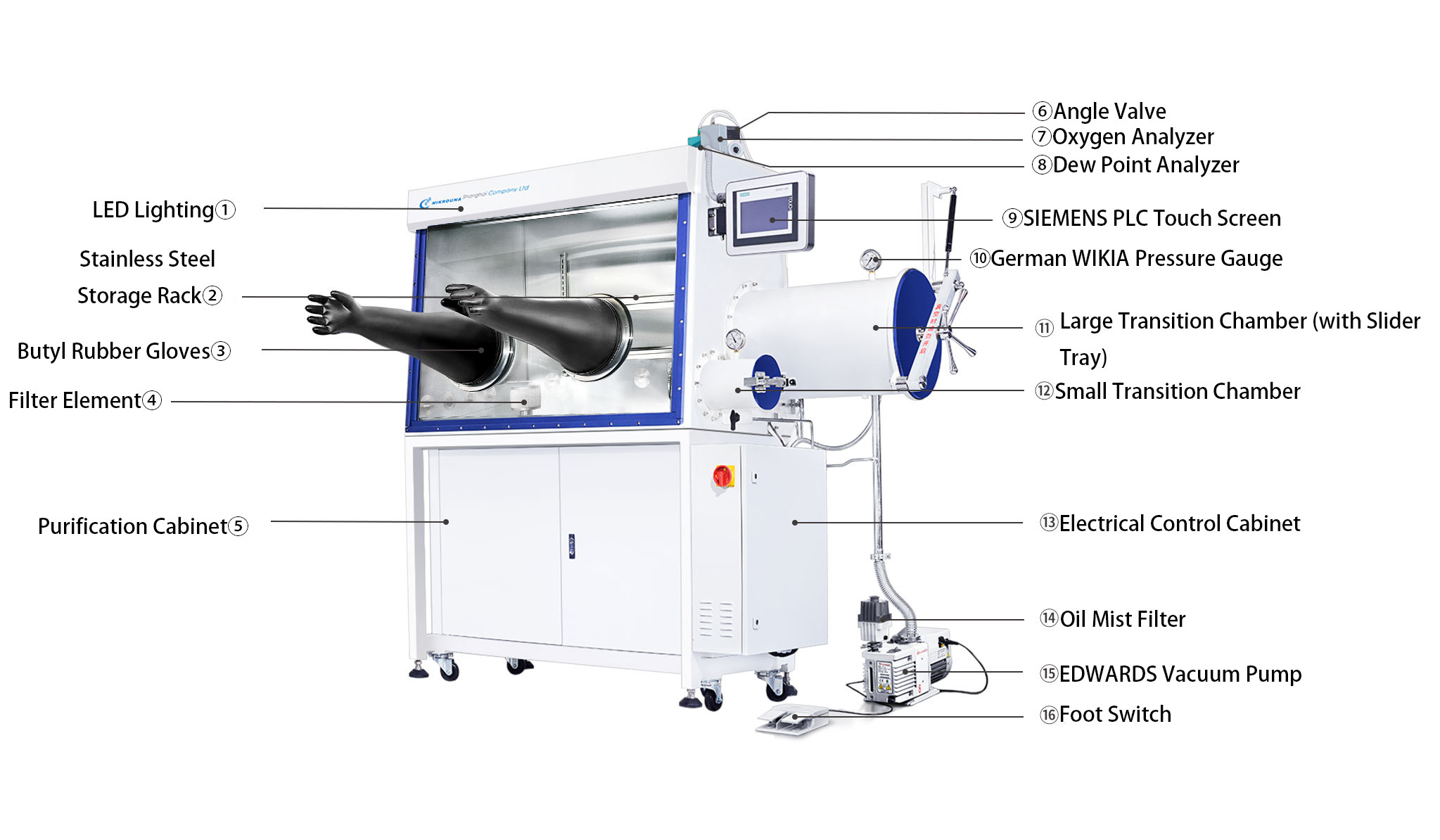
As a high-tech laboratory apparatus, a glove box is equipped with a variety of internal components, each serving distinct functions to ensure a stable, reliable, and efficient working environment. This article provides a detailed analysis of the primary equipment inside a glove box—such as filters, shelving units, and lighting systems—and explores their critical roles in its overall operation.
1. Filters
Filters are vital components within a glove box. Their primary function is to remove impurities from the internal gas, ensuring high gas purity. A typical filter features a gas inlet and outlet. During operation, gas enters through the inlet, passes through layered filter media, and exits purified via the outlet. This design maintains a consistently high-purity gas environment, essential for precision experiments. Advanced filtration systems may also include molecular sieves (to adsorb moisture) and copper catalysts (to chemically bind oxygen).
2. Shelving Units
Shelving units, usually made of corrosion-resistant stainless steel, are designed for durability and heavy-duty use. These units often have three adjustable layers, allowing users to customize the layout based on the size and shape of experimental items. Beyond storage, the shelves serve as work platforms for placing instruments or containers, optimizing space utilization and operational convenience.
3. Lighting Systems
To ensure adequate illumination, glove boxes are equipped with LED lighting systems installed within protective housings. LEDs offer advantages such as low power consumption, high brightness, and long lifespan, providing stable and uniform lighting. Researchers can adjust the brightness to suit specific experimental needs, such as enhancing visibility for detailed observations.
4. Auxiliary Equipment
Additional components further enhance functionality:
Power and Interface Ports: Multiple backup and power interfaces accommodate connections for external devices.
PLC Control Systems: Automated regeneration processes, driven by Programmable Logic Controllers (PLCs), mix working gases (e.g., nitrogen or argon) with hydrogen to maintain optimal gas conditions.
Vacuum Pumps and Circulation Fans: These enable gas cycling and vacuum sealing, ensuring environmental stability.
Transition Chambers: Stainless steel chambers with sliding trays facilitate safe material transfer without compromising internal purity.
5. Monitoring and Safety Features
Advanced models integrate real-time sensors for oxygen and moisture levels, triggering alarms if thresholds are exceeded. Some also include organic solvent adsorbers and dust filters (e.g., H13-grade filters for particles as small as 0.3 μm).
Conclusion
The diverse components within a glove box—filters, shelving units, lighting, and auxiliary systems—collaborate to create a stable, pure, and efficient environment. As technology advances, these configurations continue to evolve, offering researchers increasingly sophisticated tools for experimental precision and convenience.