Many laboratories invest in a glove box believing that adding vacuum capability automatically guarantees a cleaner or more advanced environment. The reality is more practical. Vacuum is not a universal upgrade. It is a tool designed for specific transfer, degassing, and processing requirements. If your workflow does not demand those functions, additional complexity may increase cost and maintenance without improving results. This guide explains how to evaluate inert atmosphere and vacuum glove box systems based on real laboratory use cases so you can make a technically sound decision.
Quick Decision:
Battery assembly → Inert atmosphere glove box
Degassing required → Vacuum glove box
Budget priority → Inert system (lower maintenance)
Contamination-critical research → Vacuum system
Start With Definitions So You Don’t Buy the Wrong Tool
Before comparing cost and features, it is essential to understand what each system is fundamentally designed to accomplish.
What an Inert Atmosphere Glove Box Is Designed to Do
An inert atmosphere glove box creates a sealed workspace filled with nitrogen or argon to eliminate oxygen and moisture. Its primary function is to protect air-sensitive materials during handling, weighing, synthesis, or assembly. High-quality systems maintain oxygen levels below 1 ppm and dew points below -80°C, ensuring stability for sensitive materials such as lithium salts, metal powders, nanomaterials, and pharmaceutical intermediates.
These systems rely on continuous purification, accurate sensors, pressure control, and properly designed antechambers to maintain atmosphere integrity. For most laboratories focused on battery research, chemistry synthesis, and materials science, this configuration provides reliable and efficient protection.
What a Vacuum Glove Box Adds
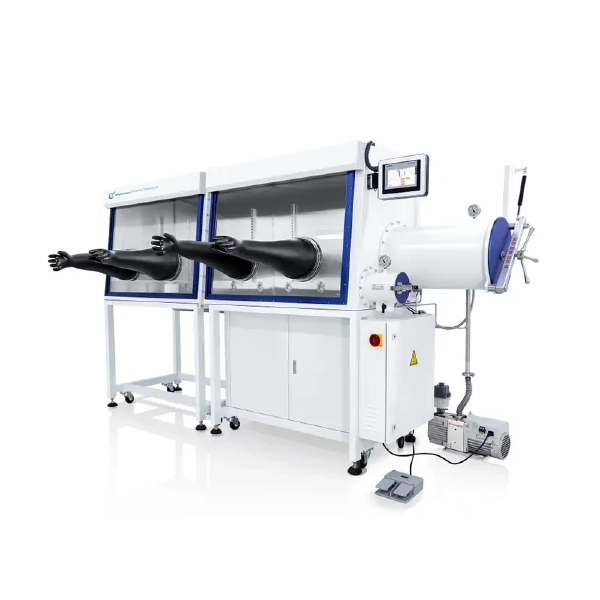
A vacuum glove box includes additional vacuum capability integrated into the system. This may involve vacuum transfer chambers, degassing functions, or the ability to evacuate processing zones before backfilling with inert gas.
Vacuum capability allows users to:
Transfer samples without exposure through vacuum purge cycles
Remove trapped gases or moisture from materials
Perform vacuum-assisted surface processing
Improve contamination control in certain advanced workflows
However, vacuum integration introduces additional components such as vacuum pumps, valves, seals, and control systems. These elements increase system complexity and require regular maintenance.
Understanding this distinction clarifies that vacuum is not simply “better.” It is specialized.
Which Glove Box for Your Application?
| Application | Recommended Type | Key Feature Needed |
| Lithium battery coin cell assembly | Inert atmosphere | Stable O₂/H₂O control (<1 ppm) |
| Vacuum degassing before electrolyte fill | Vacuum glove box | Integrated vacuum capability |
| Routine sample transfer | Inert atmosphere | Fast purge antechamber |
| Nanomaterial surface processing | Vacuum glove box | Ultra-low contamination |
| Pharmaceutical synthesis | Inert atmosphere | High throughput, stable environment |
| Thin-film deposition prep | Vacuum glove box | Vacuum-assisted processing |
Cost and Maintenance Comparison
| Factor | Inert Atmosphere | Vacuum Glove Box |
| Initial cost | Lower | Higher (vacuum system) |
| Maintenance complexity | Moderate | Higher (pump, valves, seals) |
| Gas consumption | Higher (purge cycles) | Lower (vacuum-assisted) |
| Training requirement | Standard | Additional vacuum procedures |
| Typical uptime | 98%+ | 95%+ (more components) |
When an Inert Atmosphere Glove Box Is the Best Fit
For many laboratories, an inert system provides the ideal balance of stability, efficiency, and operational simplicity.
Air-Sensitive Synthesis and Battery Assembly
Air-sensitive chemical synthesis and lithium battery assembly are among the most common applications. These workflows require stable oxygen and moisture control rather than deep vacuum capability. Materials must remain protected during handling, weighing, mixing, and assembly.
In these environments, performance is measured by atmosphere stability, recovery time after transfers, and long-term consistency. A high-quality inert glove box equipped with advanced oxygen and moisture sensors and strong purification capacity delivers excellent results without unnecessary mechanical complexity.
Daily Throughput and Fast Recovery
Laboratories operating daily require predictable workflow. Frequent antechamber transfers should not cause long recovery delays. Efficient purification and well-designed circulation systems ensure rapid stabilization after each transfer cycle.
Vacuum systems may slow routine operations if deep evacuation steps are unnecessary. For high-throughput labs, stable inert control often matters more than vacuum depth.
Cost and Complexity Sweet Spot
An inert glove box system typically requires fewer moving parts than a vacuum glove box. Reduced mechanical complexity translates into lower maintenance burden and improved uptime.
Purification modules, accurate sensors, and effective antechamber procedures create a cost-effective and technically sound solution for most laboratories. Investing in stronger purification capacity and high-grade sensors often provides more benefit than adding vacuum hardware that may rarely be used.
When a Vacuum Glove Box Is Worth It
Although inert systems are sufficient for many tasks, certain workflows genuinely require vacuum integration.
Vacuum Transfer Workflows
Some applications demand transferring materials without any risk of atmospheric contamination. Vacuum transfer chambers evacuate the transfer space before refilling with inert gas, significantly reducing contamination risk.
This approach is valuable when handling extremely sensitive powders, reactive metals, or research samples that cannot tolerate minimal oxygen exposure.
Degassing and Vacuum Processing Steps
Certain processes require removal of dissolved gases or moisture before further handling. Vacuum capability supports degassing steps or vacuum-assisted treatments directly inside or connected to the glove box.
In battery research, vacuum drying of components prior to electrolyte filling may benefit from integrated vacuum functionality. In material science, vacuum processing may be required before surface modification or thin-film preparation.
Surface-Sensitive and Contamination-Critical Procedures
Some research fields, including nanotechnology and advanced electronics, require extremely low contamination levels. Vacuum cycles help remove residual gases and reduce contamination risk during sample preparation.
In these cases, a vacuum glove box is not an upgrade for convenience but a technical requirement.
The Hidden Trade-Offs Buyers Don’t Compare
While vacuum systems offer specific advantages, they introduce operational considerations that are sometimes underestimated.
Gas Consumption Versus Pump Maintenance
Inert atmosphere glove boxes primarily consume nitrogen or argon for atmosphere maintenance and transfer cycles. Vacuum glove boxes add pump operation costs and maintenance schedules.
Vacuum pumps require regular inspection, oil changes if oil-based, and potential replacement parts. Over time, maintenance costs may offset perceived benefits if vacuum capability is rarely used.
Failure Modes and Mechanical Complexity
More components increase potential failure points. Valves, seals, and vacuum lines can degrade over time. Leaks in vacuum circuits may affect both vacuum performance and atmosphere stability.
A simplified inert system reduces mechanical exposure to such risks. For laboratories prioritizing long-term stability and minimal downtime, this difference becomes important.
Operator Training Burden
Operating a vacuum glove box requires additional procedural knowledge. Incorrect valve operation or improper pump handling can cause pressure instability or contamination events.
In high-turnover research environments, simpler systems may provide more consistent results because procedures are easier to standardize.
How to Decide in Five Practical Questions
Decision-making becomes clearer when focused on workflow requirements rather than marketing comparisons.
Do You Need Vacuum Transfer or Only Antechamber Purge Cycles?
If purge cycles with inert gas sufficiently protect materials during transfer, a standard inert system is often adequate. If contamination risk remains high even after purge cycles, vacuum transfer may be justified.
Do You Perform Degassing or Vacuum Processing Steps?
If your process requires evacuation before backfilling, or if vacuum drying is a routine part of your workflow, a vacuum glove box offers practical advantages.
Do You Handle High Vapor Loads Frequently?
Electrolyte solvents or volatile compounds can stress purification systems. While both inert and vacuum systems must manage vapor load, vacuum capability may help in specific degassing workflows. However, proper purifier sizing often solves vapor issues without vacuum integration.
What Level of Uptime Do You Require?
If daily continuous operation is critical, minimizing mechanical complexity can improve uptime. Inert systems often provide simpler maintenance routines.
What Is Your Long-Term Expansion Plan?
A modular platform that allows later vacuum integration may offer flexibility. Investing in a scalable system protects future research needs without forcing immediate overconfiguration.
Inert vs Vacuum Glove Box Comparison for Real Lab Scenarios
Scenario | Inert Atmosphere Glove Box | Vacuum Glove Box | Best Choice |
Battery coin cell assembly | Excellent stability and cost efficiency | Often unnecessary | Inert |
Vacuum degassing step required | Limited capability | Strong performance | Vacuum |
Frequent sample transfer | Good with disciplined purge routine | Great with vacuum transfer | Depends on sensitivity |
Budget and simplicity priority | Strong advantage | Higher complexity | Inert |
This comparison highlights that neither configuration is universally superior. The correct choice depends entirely on the workflow.
Modular Solutions That Cover Both Directions
Mikrouna (Shanghai) Industrial Intelligent Technology Co., Ltd., founded in 2004 with registered capital of 107 million RMB, is a high-tech enterprise integrating research, manufacturing, sales, and service. As a leading enterprise in the vacuum glove box industry, Mikrouna provides both inert atmosphere and vacuum glove box systems tailored to laboratory and industrial requirements.
With more than 500 employees and three major manufacturing bases in Shanghai, Xiaogan, and Wuqing, the company delivers scalable systems engineered for battery research, chemical synthesis, nanomaterials, and nuclear applications. Advanced oxygen and moisture sensors, modular chamber expansion, and intelligent monitoring platforms ensure that whether your laboratory requires a nitrogen glove box, argon glove box, or fully integrated vacuum glove box, the configuration matches your real workflow demands.
Instead of forcing customers into overcomplicated systems, Mikrouna designs glove box platforms that align with application triggers. Laboratories can start with inert atmosphere configurations and integrate vacuum modules later if processes evolve. This flexibility reduces unnecessary upfront investment while protecting long-term scalability.
Conclusion
The decision between inert and vacuum configurations should be based on application triggers rather than assumptions. If your goal is stable low oxygen and moisture control for daily synthesis or battery assembly, inert systems provide efficient and reliable performance. If your workflow requires vacuum transfer, degassing, or contamination-critical processing, vacuum capability becomes essential. Mikrouna supports both directions with modular architecture, high-precision monitoring, and scalable system design, allowing your laboratory to choose the right glove box solution with confidence. Contact us today to discuss how the optimal controlled atmosphere system can improve stability, protect sensitive materials, and support long-term research success.
FAQ
Is a vacuum glove box always cleaner than an inert atmosphere glove box?
Not necessarily. Cleanliness depends on oxygen and moisture control. Vacuum capability supports specific processes such as degassing or vacuum transfer but does not automatically improve daily atmosphere stability.
Can an inert glove box be upgraded later to include vacuum functions?
Yes. Modular platforms allow integration of vacuum transfer or additional chambers without replacing the entire system, protecting your investment as workflows evolve.
Which configuration is better for lithium battery research?
Most lithium battery assembly applications require stable low oxygen and moisture levels rather than vacuum processing. In such cases, inert atmosphere systems are typically sufficient unless vacuum steps are part of the process.
Does a vacuum glove box require more maintenance?
Yes. Vacuum systems include additional pumps and valves that require regular inspection and maintenance, increasing operational complexity compared to standard inert configurations.


