Yesterday your electrode coating looked perfect. Today the electrochemical performance shifts, impedance increases, and the results are inconsistent. The formula did not change. The operator did not change. What changed was exposure during transfer, drying, or assembly inside a glove box that was not truly configured for battery research. Many laboratories purchase equipment based on headline specifications, only to discover later that recovery time, transfer discipline, or sensor stability quietly affects data quality. By the end of this guide, you will know exactly what to buy based on your battery workflow, not marketing claims.
What Battery Researchers Really Need a Glove Box to Prevent
Battery research is unforgiving. Small amounts of moisture or oxygen can affect lithium salts, electrolyte stability, and metal surfaces long before the contamination becomes visible.
Moisture-Driven Failures
Moisture is often the first hidden enemy in lithium battery laboratories. Electrolytes containing LiPF6 are highly sensitive to water, which can trigger decomposition reactions and form HF. This not only damages cell components but also introduces long-term reliability issues. Moisture exposure during powder weighing or electrolyte handling may seem minor, yet it can significantly alter surface chemistry.
A properly configured battery glove box must maintain ultra-low moisture levels consistently, not just reach a low number once during commissioning. Stability over time matters more than a single impressive dew point reading.
Oxygen-Driven Oxidation
Oxygen is equally problematic, especially when handling lithium metal, sodium metal, or other highly reactive materials. Even trace oxygen levels can oxidize surfaces, reduce conductivity, and affect cycling performance.
A battery glove box designed for lithium metal research must maintain extremely low oxygen levels with high-precision sensors and reliable sealing. Otherwise, oxidation occurs gradually and affects reproducibility.
Transfer Mistakes Become Hidden Variables
Antechamber procedures are often underestimated. Poor purge discipline, frequent door openings, or oversized transfer cycles can introduce contamination repeatedly. Over time, these small events accumulate and destabilize the atmosphere.
A well-designed glove box for battery research must support fast recovery, efficient antechamber cycling, and clear monitoring so that transfer does not become an uncontrolled variable in experiments.
Define Your Battery Workflow First Because Specs Follow Process
Choosing the right glove box begins with understanding your battery research process. Different workflows demand different system configurations.
R&D Coin Cells vs Pilot Line Pouch Cells
Coin cell assembly in an R&D lab typically involves small-batch material handling, weighing, stacking, and crimping. Stability and flexibility are key. A single-station glove box with strong purification and stable oxygen and moisture control may be sufficient.
Pilot line pouch cell production requires more space, more frequent transfers, and potentially multiple operators. In this case, a modular glove box system with expansion capability, multiple chambers, and coordinated atmosphere control becomes critical.
Steps That Demand Controlled Atmosphere
Battery research typically includes:
Active material weighing
Slurry sample handling
Separator preparation
Lithium metal cutting
Electrolyte filling
Cell assembly
Each of these steps may introduce moisture or oxygen if not properly controlled. The glove box must support these processes without constant interruptions or long recovery periods.
When a Simple Dry Box Is Not Enough
A basic dry cabinet may reduce humidity but cannot provide consistent oxygen control, pressure stability, and efficient transfer. For lithium battery research, especially involving sensitive chemistries, a fully integrated battery glove box with purification, monitoring, and modular expansion is necessary to ensure research consistency.
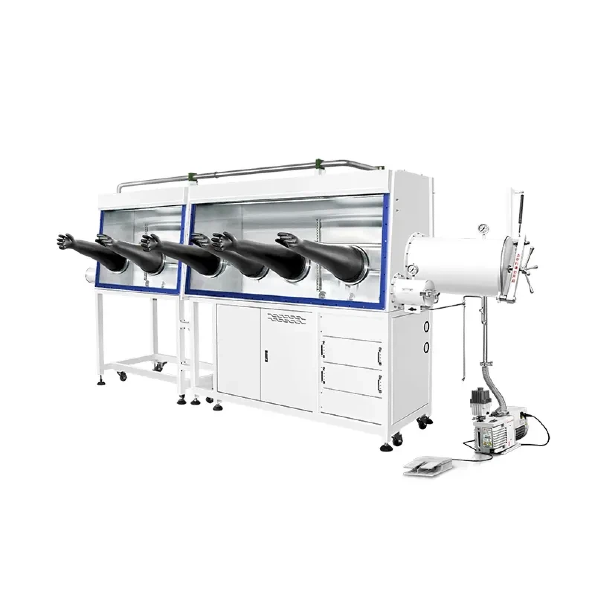
The 6 Specs That Matter Most for a Battery Glove Box
Many buyers focus only on low ppm numbers. However, true performance lies in long-term stability and system integration.
Oxygen and Moisture Targets
Oxygen and moisture levels are usually expressed in ppm and dew point. For advanced lithium battery research, oxygen levels below 1 ppm and dew points below -80°C are often required. More important than the initial reading is how quickly the system recovers after transfers and how stable it remains during daily operation.
Purification Capacity and Stability
Purification systems remove oxygen and moisture continuously. A high-quality purifier must not only achieve low levels but also maintain them under real working conditions. If solvent vapors are frequently introduced, purifier capacity becomes even more important. Saturation of purification media can lead to slow performance degradation.
Antechamber Size and Pump Performance
Antechamber design directly affects workflow efficiency. Too small, and it slows down transfers. Too large, and it increases purge time and contamination risk. Pump performance must allow fast evacuation and refill cycles without causing pressure instability.
Efficient transfer systems reduce downtime and maintain atmospheric integrity.
Sensor Quality
Not all sensors provide the same reliability. High-precision oxygen analyzers and moisture sensors are essential for accurate monitoring. Drift in sensor readings can lead to incorrect assumptions about atmosphere stability.
Advanced systems utilize German-standard ZrO2 oxygen sensors and P2O5 moisture sensors to provide stable, long-term measurement accuracy. This level of monitoring supports traceable and repeatable battery research.
Materials and Sealing Strategy
Stainless steel glove boxes are typically preferred for battery research because of durability, sealing reliability, and chemical resistance. Acrylic or plastic variants may be suitable for educational purposes but may not provide the same long-term sealing stability for sensitive lithium research.
Sealing components such as gloves, O-rings, and gaskets must also be selected carefully to ensure consistent pressure control.
Informatization and Data Logging
Modern research requires traceability. Monitoring platforms that log oxygen and moisture data help identify performance trends and prevent unnoticed degradation.
An integrated monitoring system enables real-time diagnostics and alarm systems, reducing risks to valuable battery materials.
Nitrogen vs Argon for Battery Research A Practical Rule Set
Gas selection affects cost, performance, and compatibility with materials.
When Nitrogen Is Sufficient
For most lithium battery research applications, nitrogen glove boxes are cost-effective and suitable. Nitrogen provides a stable inert atmosphere for moisture-sensitive operations and general battery assembly.
For coin cell assembly and standard lithium-ion chemistry development, nitrogen often delivers reliable performance at lower operational cost.
When Argon Is Safer
Argon glove boxes are preferred when working with highly reactive metals or when stricter oxygen control is required. Argon is heavier than nitrogen and may provide improved inertness for certain advanced chemistries.
If your research involves extremely reactive lithium metal or sodium metal, argon may offer additional safety margins.
How to Choose Without Overspending
Match the gas choice to your chemistry. If nitrogen meets your oxygen and moisture targets and provides stable performance, it remains the economical choice. Upgrade to argon only when the application truly demands it.
A modular glove box design allows future gas system upgrades without full replacement, protecting your long-term investment.
The Buying Checklist Most Labs Miss
Even with excellent specifications, some details determine long-term success.
Glove Choice and Integrity Routine
Gloves are the direct interface between operator and controlled atmosphere. Chemical compatibility, flexibility, and durability matter.
Regular glove integrity checks and timely replacement prevent micro-leaks that gradually increase oxygen levels. Establishing a clear inspection routine ensures stable performance.
Solvent Vapor Management
Electrolyte solvents can affect purifier performance. If your battery research frequently introduces solvent vapors, the glove box must support vapor management and maintain purifier efficiency.
Ignoring vapor load may reduce purifier lifespan and increase maintenance frequency.
Expansion Plan
Research projects evolve. A modular glove box system that allows additional chambers, vacuum transfer integration, or process equipment installation reduces future capital expenditure.
Instead of replacing an entire system, expansion modules can be added as your battery research moves from R&D to pilot scale.
Glove Box Specifications for Battery Research
| Parameter | Basic Research | Advanced R&D | Production Scale |
| O₂ control | <1 ppm | <0.1 ppm | <0.1 ppm |
| H₂O control | <1 ppm | <0.1 ppm | <0.1 ppm |
| Chamber size | 1-2 operator | 2-3 operator | 4+ operator |
| Antechamber | Standard | Large capacity | Automated transfer |
| Purifier capacity | Standard | High capacity | Dual/backup |
| Recovery time | <30 min | <15 min | <10 min |
| Typical budget | $15,000-30,000 | $30,000-60,000 | $60,000+ |
Key Accessories for Battery Research
| Accessory | Function | When Needed |
| Solvent trap | Capture electrolyte vapors | When handling liquid electrolyte |
| Dew point sensor | Monitor moisture | High-sensitivity applications |
| Heated antechamber | Pre-dry materials | For moisture-sensitive materials |
| Integrated battery cycler | Test cells in-box | In-line research workflow |
| Transfer container | Move cells without exposure | Multi-glovebox facilities |
Battery Research Task to Recommended Glove Box Setup
Battery Task | Risk Driver | Recommended Glove Box Features | Typical Mistake to Avoid |
Coin cell assembly | H2O and O2 ingress | Stable low O2 and moisture control, efficient antechamber | Opening inner door too early |
Lithium metal handling | Oxygen sensitivity | Tighter oxygen control, reliable sensors | Ignoring small oxygen spikes |
Powder weighing | Moisture pickup | Strong purification, fast recovery | Frequent unnecessary openings |
Electrolyte work | Vapor load | Solvent management support | Purifier saturation |
This mapping approach ensures that glove box configuration directly matches battery research workflow.
Conclusion
Selecting the right glove box for battery research follows a clear logic: define your workflow, determine oxygen and moisture targets, optimize transfer efficiency, and ensure long-term stability. Mikrouna (Shanghai) Industrial Intelligent Technology Co., Ltd., founded in 2004 and recognized as a leading enterprise in the vacuum glove box industry, delivers research-to-production ready solutions with advanced sensor technology, modular scalability, and intelligent monitoring systems. Headquartered in Shanghai with three major manufacturing bases and a sales center in the United States, Mikrouna supports laboratories worldwide with reliable battery glove box systems designed for consistent lithium research performance. If you are ready to upgrade your controlled atmosphere workflow, contact us today to discuss the optimal configuration for your battery laboratory and discover how a professionally engineered inert atmosphere enclosure can protect your research and improve reproducibility.
FAQ
What oxygen and moisture levels are recommended for a battery glove box?
For most lithium battery research, oxygen levels below 1 ppm and dew points below -80°C are recommended to protect sensitive materials and ensure stable electrochemical performance.
Is nitrogen sufficient for lithium battery research?
In many cases, nitrogen glove boxes provide stable and cost-effective inert environments for standard lithium-ion development. Argon is recommended for extremely reactive materials or stricter oxygen control requirements.
How often should glove box sensors be calibrated?
Sensor calibration frequency depends on usage intensity and laboratory standards. Regular calibration ensures accurate oxygen and moisture monitoring and prevents undetected atmosphere drift.
Can a battery glove box be expanded later?
Yes. Modular glove box systems allow additional chambers, vacuum transfer integration, and system upgrades without full replacement, supporting future research expansion.


