“If your glove box reads low moisture but your samples still degrade, the problem usually isn’t the display—it’s the source of moisture.” That sentence summarizes one of the most common misunderstandings in laboratories that rely on a glove box for air-sensitive work. Researchers often assume that once a low dew point is achieved, the environment is permanently safe. In reality, moisture control inside a glove box is dynamic. It depends on workflow discipline, purification capacity, sensor accuracy, and long-term monitoring. Understanding how glove box moisture control truly works is the key to improving repeatability, protecting sensitive samples, and eliminating unexplained experimental drift.
Why Moisture Is the Quiet Enemy
Moisture often receives less attention than oxygen, yet in many applications it causes greater instability.
Moisture Changes Reactions, Surfaces, and Yields
Water molecules are small, reactive, and capable of altering materials at the molecular level. In lithium battery research, trace moisture can decompose electrolyte salts and create unwanted byproducts. In organometallic synthesis, water can destroy catalysts or alter reaction pathways. In nanomaterials, surface adsorption of moisture changes conductivity and structural stability.
Even when oxygen remains low, residual moisture can cause long-term degradation. That is why glove box moisture control must be treated as a core system function rather than an optional performance feature.
Moisture Spikes Come From Routine Actions
Laboratory contamination is rarely dramatic. Instead, small moisture spikes occur during normal activities:
Transferring materials through the antechamber
Introducing tools that were not fully dried
Handling containers that absorbed humidity outside the system
Performing operations involving solvents
Over time, these small events reduce stability. Moisture control is therefore not only about achieving low numbers but about maintaining consistent performance during daily operation.
Dew Point vs ppm: What Do These Numbers Actually Mean?
Moisture inside a glove box is usually described using dew point or parts per million. Many users see these values but do not fully understand their relationship.
Lower Dew Point Means a Drier Environment
Dew point refers to the temperature at which water vapor condenses into liquid. The lower the dew point, the less moisture is present in the atmosphere. A dew point below -80°C indicates an extremely dry environment suitable for sensitive research.
PPM measures concentration directly. For most advanced applications, moisture levels below 1 ppm are desirable. While ppm provides a clear numerical target, dew point offers a practical interpretation of dryness.
Stability Is More Important Than a Single Reading
A glove box may display an impressive dew point during commissioning. However, stability over time defines real performance. If moisture levels fluctuate significantly after each transfer, sample integrity may suffer even if the system eventually recovers.
True glove box moisture control requires consistent values during active operation, not just during idle periods.
Where Moisture Comes From Inside a Glove Box
Understanding sources of moisture is essential for prevention.
Antechamber Transfer
The antechamber is the most common pathway for moisture entry. If purge cycles are rushed or incomplete, residual humidity remains inside the transfer chamber. When the inner door is opened, moisture enters the main workspace.
Proper purge protocols, adequate evacuation cycles, and disciplined operator habits significantly reduce this risk.
Gloves, Tools, and Containers
Gloves themselves can absorb moisture from ambient air. Tools stored outside the system may carry microscopic water layers. Plastic containers can trap humidity within their surfaces.
Pre-drying materials and establishing strict storage procedures improve long-term stability.
Solvents and Sample Outgassing
Solvents used in research may release vapor into the atmosphere. Samples stored under ambient conditions may slowly outgas moisture after being introduced into the glove box.
Without sufficient purification capacity, these sources gradually increase humidity levels.
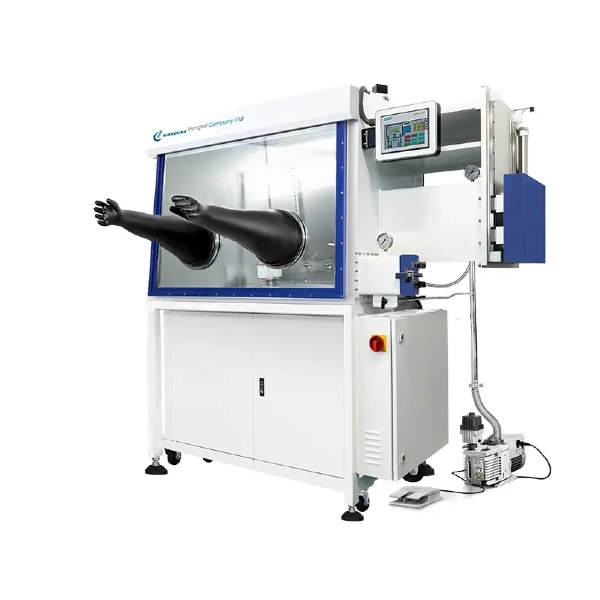
How Purification Removes Moisture Without Over-Engineering
Purification systems are central to glove box moisture control. However, understanding how they function clarifies why capacity and design matter.
Adsorption and Chemical Removal
Most glove box systems remove moisture through adsorption materials or chemical reactions. Adsorption media capture water molecules on their surfaces, while chemical removal methods bind water through reactive processes.
High-efficiency purification modules continuously circulate atmosphere through these media, reducing moisture levels until equilibrium is achieved.
Why Purifier Capacity Matters
Purifier capacity determines how much moisture the system can remove before saturation. When purification media become saturated, moisture levels rise slowly and recovery times increase.
Signs of purifier saturation include:
Moisture levels that do not return to baseline
Longer recovery after transfers
Gradual upward drift over days or weeks
A properly sized purification system ensures stable operation even under heavy workflow conditions.
Why Sensors Matter: Moisture Measurement Is a System
Moisture control depends not only on purification but also on accurate measurement.
Understanding P2O5 Moisture Sensing
Advanced glove box systems use high-precision moisture sensors such as P2O5-based analyzers. These sensors detect extremely low water concentrations and provide reliable data for demanding research environments.
Accurate sensing prevents false confidence. Without reliable measurement, operators cannot detect small but meaningful changes.
Oxygen and Moisture Sensors Work Together
Moisture and oxygen levels often rise together when leaks or poor transfers occur. Monitoring both parameters allows laboratories to diagnose issues quickly. If oxygen remains stable but moisture rises, the source may be solvent vapor rather than leakage.
Integrated monitoring improves troubleshooting accuracy and protects sensitive samples.
Data Logging Turns Drift into Action
Short-term fluctuations may go unnoticed without continuous logging. Intelligent monitoring platforms record oxygen and moisture trends over time. When gradual drift appears, maintenance or workflow adjustments can be implemented before major problems occur.
This proactive approach transforms moisture control from reactive troubleshooting into predictive stability management.
Moisture Spike Causes and Fixes
Moisture Spike Cause | What It Looks Like | Immediate Action | Long-Term Prevention |
Poor antechamber purge | Sudden jump after transfer | Re-purge correctly | Standardize transfer SOP |
Wet tools or containers | Slow rise over hours | Remove and dry items | Pre-dry materials before entry |
Purifier saturation | Levels do not recover | Regeneration or service | Scheduled maintenance plan |
This table demonstrates that moisture problems are rarely mysterious. They are usually linked to identifiable causes that can be corrected systematically.
Building a Workflow + Equipment Strategy
Moisture control succeeds when equipment and procedure work together.
A high-quality glove box system provides:
Stable circulation and purification
High-precision moisture sensors
Efficient antechamber design
Intelligent monitoring and alarm systems
Operators complement these features with disciplined transfer routines, proper material preparation, and scheduled maintenance.
Mikrouna (Shanghai) Industrial Intelligent Technology Co., Ltd., founded in 2004 with a registered capital of 107 million RMB, integrates research, development, manufacturing, and service to deliver advanced glove box systems worldwide. As a leading enterprise in the vacuum glove box industry, Mikrouna designs modular systems that combine German-standard ZrO2 oxygen sensors and P2O5 moisture sensors with scalable purification capacity and informatization management platforms.
Headquartered in Shanghai with manufacturing bases in Shanghai, Xiaogan, and Wuqing, and supported by a sales center in the United States, Mikrouna provides solutions tailored to battery research, chemical synthesis, nanomaterials development, and nuclear applications. The company’s modular architecture allows expansion from single-station units to multi-chamber networks while maintaining consistent atmosphere integrity.
Moisture control is not treated as a static feature but as an integrated system that supports repeatability, safety, and long-term productivity.
Conclusion
Effective glove box moisture control is a combination of purification, precise measurement, disciplined workflow, and intelligent monitoring. Low dew point readings alone do not guarantee protection; stability during real operation defines success. Mikrouna designs advanced purification systems, high-precision sensor integration, and scalable modular platforms to ensure consistent performance across demanding laboratory applications. If your laboratory is experiencing unexplained drift or wants to improve atmosphere stability, contact us to explore how a professionally engineered inert atmosphere enclosure can deliver reliable dryness and protect your most sensitive samples.
FAQ
What dew point is recommended for sensitive battery research?
For lithium battery and moisture-sensitive applications, dew points below -80°C are typically required to prevent electrolyte degradation and surface reactions.
Why does moisture rise even when oxygen remains low?
Moisture may originate from solvents, absorbed water in materials, or incomplete purge cycles. Monitoring both oxygen and moisture helps identify the source.
How often should purification systems be regenerated?
Regeneration frequency depends on workflow intensity and vapor load. Monitoring moisture trends through data logging helps determine optimal maintenance timing.
Can better sensors really improve experimental repeatability?
Yes. High-precision moisture sensors provide accurate trend data, allowing early detection of drift and preventing unnoticed contamination events.


