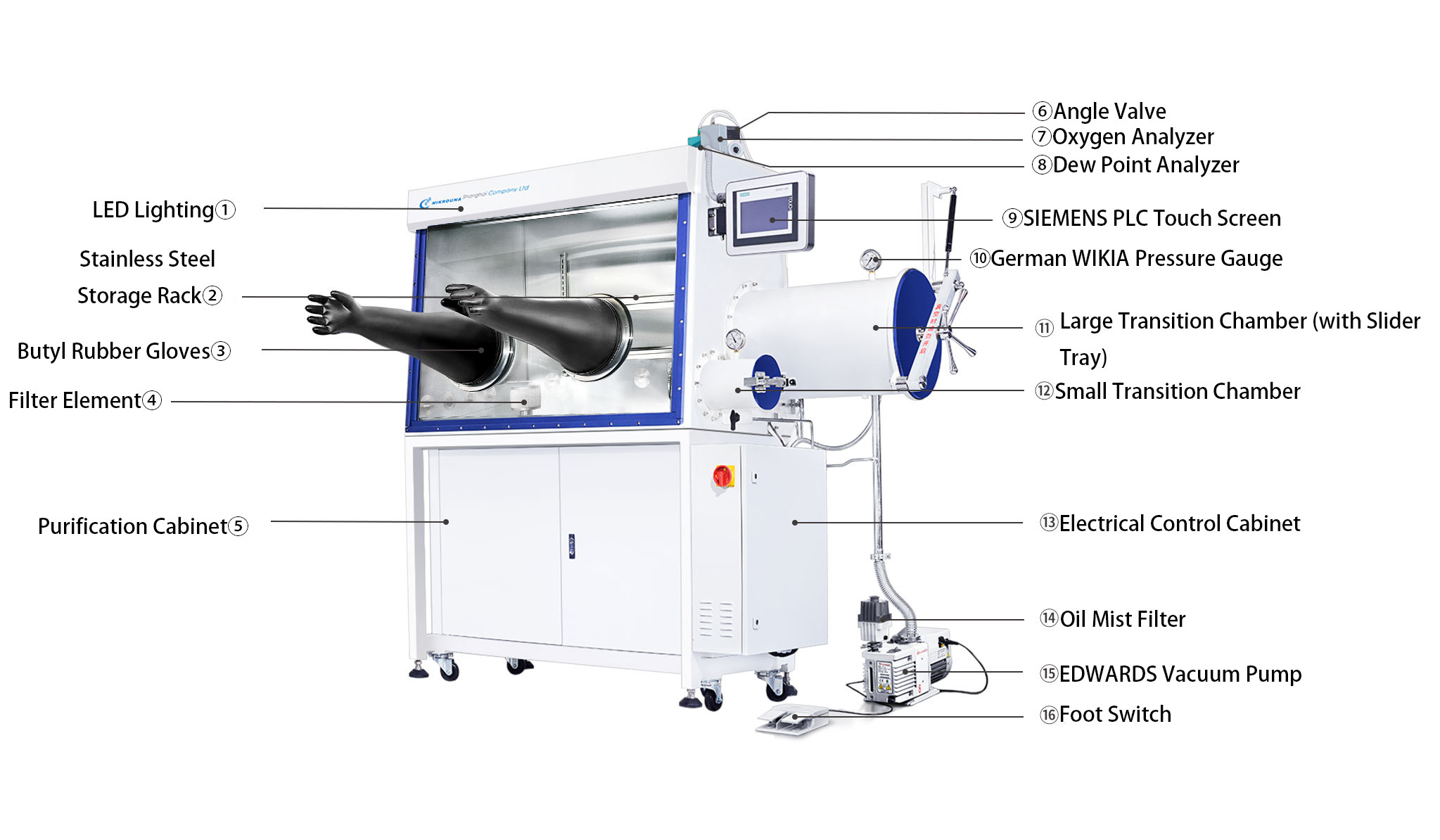
In many fields such as scientific research and industrial production, glove boxes are used in experiments and production operations that are sensitive to air or require high-purity environments. During the operation, it is often necessary to transfer items from outside the glove box into the glove box. Due to the difference in their physical states, solid and liquid samples have significantly different processing methods when moved into the glove box.
Structure and function of glove box and transition compartment
A glove box usually consists of a main box body, a transition compartment, and related gas purification systems, pressure control systems, etc. The main box is the area where sample operations are carried out, and the water and oxygen content in its internal environment can be precisely controlled at an extremely low level to meet the processing requirements for air sensitive samples. The transition compartment is a key component that connects the external environment with the main body of the glove box, and is divided into a small transition compartment and a large transition compartment. The small transition compartment is mainly used for the daily entry and exit of small samples, tools, etc., while the large transition compartment facilitates the transfer of some large items. The transition compartment is equipped with suction and inflation pipelines, vacuum state pressure gauges, as well as inlet and outlet valves and other components. These components work together to enable the transition compartment to be filled with inert gases such as high-purity argon or nitrogen after vacuuming, effectively removing air and creating conditions for the safe transfer of samples.
Processing method for transferring solid samples into glove boxes
Firstly, ensure that the glove box is in normal operation and check if the tools are complete, clean, and free of contamination, such as tweezers, spoons, and other tools used for transferring solid samples.
Choose a suitable container based on the properties of the solid sample. Solid samples that do not react with water and oxygen can be placed directly in an open container;
For solid samples that are prone to oxidation or moisture absorption, containers with good sealing performance should be selected, such as glass vials or metal containers with sealed lids;
For some small powder like solid samples, they may fly out during the transfer process due to vacuum pumping and other operations, contaminating the transition compartment and even blocking the suction and inflation pipelines. It is recommended to use a plug with air permeability that can block the powder to seal the container tightly.
Processing method for transferring liquid samples into glove boxes
Check and prepare tools for liquid sample transfer, such as pipettes, syringes, etc., to ensure they are clean and free of contamination.
For volatile or corrosive liquid samples, suitable transfer tools should be selected. For example, glass pipettes can be used for most non corrosive liquid samples, while specialized corrosion-resistant pipettes are required for highly corrosive liquid samples. When transferring, attention should be paid to the changes in the state of the liquid sample in a vacuum environment. For some liquid samples with lower boiling points, boiling may occur. Therefore, the time and frequency of vacuuming should be adjusted appropriately according to the properties of the sample.
For liquid samples that have already been exposed to air, if there is concern about the presence of moisture or oxygen impurities, some pre-treatment can be carried out first, such as distillation, and then the processed sample can be transferred to a sealed container and placed in a transition compartment with a glove box.
Whether it is a solid sample or a liquid sample, the transfer tool should be cleaned in a timely manner after being moved into the glove box, so that subsequent sample operations can proceed smoothly. At the same time, operators should strictly follow the operating procedures of the glove box to avoid human errors affecting the quality of samples and the normal operation of the glove box. Throughout the entire transfer process, full consideration should also be given to the chemical and physical properties of the sample, as well as the environmental conditions inside the glove box, to ensure that each step is completed safely, efficiently, and accurately.